Membership
Become a part of our giving and amplify your impact.
Learn More

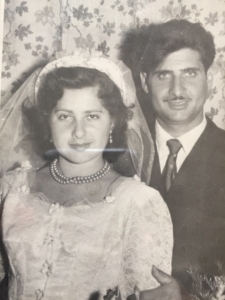
Helen and Simon Kaltman on their wedding day in Israel in 1957
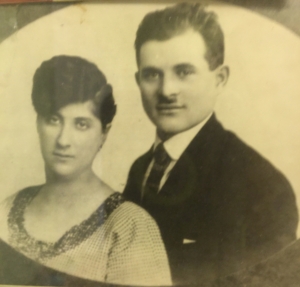
When the Nazis invaded Poland in 1939, Elana’s grandparents, Hershel and Sonia Kaltman, were forced to move with their five children, including her father, from their home in Lodz, Poland, to a tiny, austere apartment in the Lodz Ghetto, about 85 miles southwest of Warsaw. Before leaving their rightful home, they hid their Sabbath candlesticks, Torah and other valuables in a barrel and buried it in the ground. They never retrieved it.
Life in the ghetto meant no running water or sewer system, overcrowding and, often, starvation, especially during winter months. Circumstances became much worse when a decree from the German government in Sept. 1942 mandated that the elderly, ill and children under 10 were to be taken, ostensibly because they were useless to the German war machine.
“My grandparents hid their 10-year-old daughter in a bureau,” Elana relates. The family lost their five-year-old daughter, however, who was taken along with others and murdered in Chelmno, a town in northern Poland.
In September 1944, remaining family members were packed onto a train and told they were being sent to a farm. Arriving at their true destination, Auschwitz, Poland, they were lined up for a selection process, and Elana’s grandmother and her aunt (then 12), were sent to the gas chamber. Hershel, her grandfather, spoke up to say he had skills as a locksmith and needed his three sons to assist him, including Elana’s then 17-year-old father.

Brothers Simon, Sam and Abraham Kaltman.
As Allied forces gained strength, the Nazis sent their prisoners at Auschwitz next to Dachau in Germany and then on a death march in 1945. Hershel and his sons were liberated in Tyrol, Austria. They had escaped and were hiding in a barn when an Allied soldier discovered them and declared in Yiddish, “You are free.”
Alana’s grandfather, Hershel took up residence in Palestine. Simon served for 10 years in the Israeli army. After that, Simon and Helen were sponsored by his brother, Sam, to join his family in Cincinnati. Simon and Helen arrived in Cincinnati in 1960.
Rebuilding
Elana summarizes how her family rebuilt their lives in Cincinnati: “My dad learned English, and he and my uncle became plumbers. Their kids went to college and our kids went to college. The Nazis did not succeed in killing us.
“I have four kids and my sister has four kids. My mother, who is now 88, has 20 great- grandchildren. I know many of the people featured in the museum. My mom’s best friend Zahaba is one of the main people whose story is highlighted there.”
Elana is training to be a docent at the museum. “I want people to see how important it is to be a good human and make the right choices. To see how bad things can get if you don’t,” she continues.
She and all who attended the Impact 100 event also did a workshop that examined people’s character strengths, evaluated by an online assessment completed before the event. “Honesty was my lead strength,” she says. “Whatever your character strength, you can cultivate it to do the right things and make good choices. Ask yourself how you can act to be an upstander, rather than a bystander or perpetrator. For me, I was a nurse for 41 years at Jewish Hospital. I did the little things to see satisfaction in the faces of my patients.”
She urges all of us to “educate yourself and be involved.”
The Nancy and David Holocaust & Humanity Center is hosting an Upstander 5K and Family Day event on Saturday, June 29. A talk by Kathrine Switzer, the first female to run the Boston Marathon, and family activities follow the 5K.